
FLUX 3 Max vs FLUX 3: We Timed Both — 21s vs 76s for a 10-Second Clip

As of October 20, 2026: FLUX 3 Max is fal’s post-trained, low-latency version of Black Forest Labs’ FLUX 3 video model, released on October 19. In our day-one test with the same prompt at 720p, FLUX 3 Max returned a 10-second text-to-video clip in 21 seconds; FLUX 3 took 76 seconds. The list price is the same.
The launch claim is bold: a 10-second video in about 12 seconds, tied for first place on image-to-video quality, and roughly 22× faster than Seedance 2.5 at the same quality (fal press release). Those are vendor numbers. So the morning after launch we ran both models side by side on fal, with the same prompt, the same image, audio off, and recorded the wall-clock time a user would actually wait.
We also wired FLUX 3 Max into the SunoMV clip editor on the same day. It ships with the next SunoMV release, so it is not in the model picker yet. This page is the test log and the decision guide for music-video work: when Max is the right pick, and when a face-locked model still wins.
Table of Contents
- What FLUX 3 Max is (and is not)
- Speed test: same prompt, same settings
- Quality: who followed the prompt
- Price and features side by side
- Music videos: when to pick Max, when to pick Seedance
- What comes next
- FAQ
What FLUX 3 Max is (and is not)
FLUX 3 is Black Forest Labs’ video model. It shipped in August 2026 with text-to-video, image-to-video, first-and-last-frame, keyframes, video editing and extension. FLUX 3 Max is not a new base model. fal Research post-trained FLUX 3 together with Black Forest Labs for two things: stronger prompt adherence and much lower latency (fal model page).
On the Artificial Analysis image-to-video leaderboard, fal reports Max at 1,138 Elo at launch. That ties Dreamina Seedance 2.5 and sits two points behind MiniMax H3. fal itself calls the ranking preliminary.
What Max keeps from FLUX 3:
- Text-to-video, image-to-video (with an optional last frame) and keyframes-to-video
- 5–20 second output, native audio, a
reasoning_levelswitch (high by default, where the model expands your prompt)
What Max drops:
- No video editing or extension endpoints
- No 2K or 4K. Output is 720p, with 1080p billed as a separate tier
Practical rule: Max is FLUX 3 tuned for speed and obedience, not a bigger model. If you needed FLUX 3 for editing or 4K, keep FLUX 3.
Speed test: same prompt, same settings
The test ran on October 20, 2026 against fal’s public endpoints, with all jobs submitted at the same moment. Text-to-video used a 10-second, 16:9, 720p clip with audio off. Image-to-video used one portrait photo as the first frame, 5 seconds, 720p, audio off. “Wait” means wall-clock time from submit to a finished file. That includes queueing, which is what a creator actually feels.
| Job | FLUX 3 | FLUX 3 Max (high) | FLUX 3 Max (low) |
|---|---|---|---|
| Text-to-video, 10s | 76 s | 21 s | 13 s |
| Image-to-video, 5s | 84 s | 16 s | — |
| Max speed-up | — | 3.6× / 5.3× | 5.7× |
The 13-second low-reasoning run lands close to fal’s “10 seconds in about 12 seconds” claim. fal’s own timing field put pure inference at about 9 seconds for both 10-second Max jobs. The high-reasoning job spends the extra seconds rewriting the prompt before it renders.
We did not test Seedance 2.5 in this run, so we are not repeating the 22× figure as our own. What we can say: on the same fal account, the gap to FLUX 3 is about 4–5×, not 20×.
Practical rule: Judge video models by the wall-clock wait, not the inference number. Queue time is part of what you pay in attention.
Quality: who followed the prompt
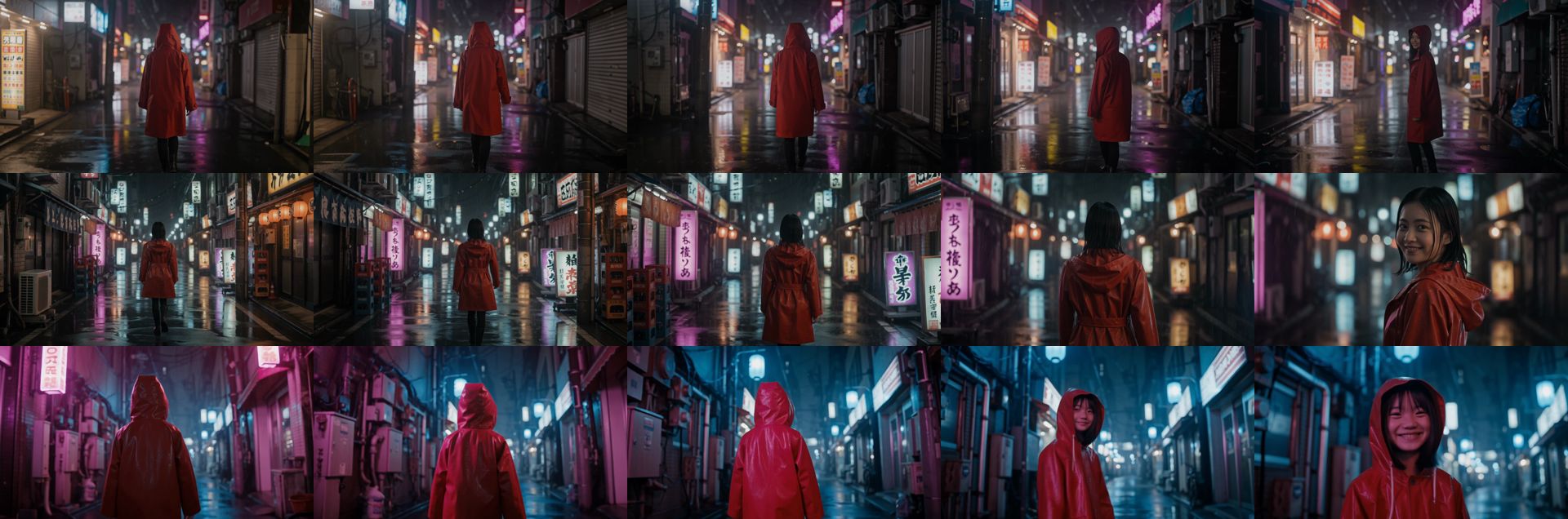
The text-to-video prompt was deliberately demanding about camera and action. It asked for a girl in a red raincoat in a neon Tokyo alley at night, rain, the camera slowly dollying behind her, and at the end “she turns her head and smiles at the camera”. Below are five frames from each 10-second clip, top to bottom: FLUX 3, FLUX 3 Max (high), FLUX 3 Max (low).
Image: SunoMV Team test, October 20, 2026 · rows top to bottom: FLUX 3, FLUX 3 Max high, FLUX 3 Max low
FLUX 3 kept the camera behind the subject for almost the whole clip. Only the last frame turns partly toward the camera, and there is no clear smile. The alley is moody but sparse.
Max on high reasoning did the full script. The camera follows, pushes in, she turns, and the final frame is a clear smile toward the lens. The signage, lanterns and wet reflections are noticeably richer, which matters when a clip has to hold up behind lyrics.

Image: SunoMV Team test · FLUX 3 Max, reasoning_level high, 10s at 720p, about 21 seconds to generate
Max on low reasoning also hit the turn and the smile. But the grade went heavy on magenta and teal, the framing jumped to a tight push-in, and the character reads noticeably younger than the other two runs. For a music video where the singer has to look like the same adult across 20 clips, that drift is a dealbreaker. That is why SunoMV’s integration pins Max to high.

Image: SunoMV Team test · FLUX 3 Max, reasoning_level low · fastest run (13 seconds), weakest character match
On image-to-video, the two models were close. Both kept the face from the source photo stable through a slow head turn. The real difference was the 16-second versus 84-second wait.
Practical rule: Low reasoning saves eight seconds and costs you the character. For anything with a recurring face, stay on high.
Price and features side by side
At list price, Max costs the same per second as FLUX 3. From October 15 to November 7, fal runs Max at 75% off (fal model API), so during the promotion it is the cheaper of the two.
| FLUX 3 | FLUX 3 Max | |
|---|---|---|
| fal list price, 720p / 1080p per second | $0.17 / $0.29 | $0.17 / $0.29 |
| Promo price until Nov 7 | — | $0.0425 / $0.0725 |
| 10s clip at 720p, list | $1.70 | $1.70 |
| Text-to-video / image-to-video / first + last frame / keyframes | ✅ | ✅ |
| Video editing, extension | ✅ | ❌ |
| 2K / 4K | ✅ (via OpenRouter) | ❌ |
| Character face-lock references | ❌ | ❌ |
SunoMV bills Max at the same credits per second as FLUX 3, because the list price is the same. We don’t move credit prices for a temporary promo.
That last row in the table is the one most people miss. FLUX 3’s “reference-to-video” endpoint is keyframe interpolation. You place images at time points and the model moves between them. It does not take a cast of character photos and keep a face consistent across shots. Max inherits exactly that behavior.
Practical rule: “Reference-to-video” on FLUX models means keyframes, not face lock. Don’t expect it to remember your singer.
Music videos: when to pick Max, when to pick Seedance
Most SunoMV projects are image-driven: a singer portrait, a couple of locations, and storyboard stills per lyric line. That workflow leans on models that accept up to nine reference images and lock identity across clips. Our default is Seedance 2.0 Fast for exactly that reason. The full method is in our character consistency guide.
| Your clip | Pick | Why |
|---|---|---|
| Recurring singer or cast, turning, close-ups | Seedance 2.0 / 2.5 or H3 Max | Up to 9 reference images lock the face; lipsync from audio |
| Lyric line already drawn as a still, little head movement | FLUX 3 Max | Storyboard still as first frame, 4–5× faster than FLUX 3 |
| Establishing shots, landscapes, b-roll, title cards | FLUX 3 Max | No face to keep; speed and prompt adherence win |
| Need editing, extension or 4K | FLUX 3 | Max has none of these |
When you pick a FLUX model on a clip that has cast references attached, SunoMV only sends the storyboard still. The cast photos stay on the reference bar but are not used. Starting with the next release, the clip editor says this in plain words, so a fast draft doesn’t quietly drift away from your singer.
The fastest workflow we found: draft and iterate on b-roll and wide shots with Max, then shoot the performance clips with a face-locked model. Paste a Suno link into the SunoMV audio-to-video generator to start a project. Use FLUX 3 today, and switch to Max once the next release lands.
For prompt structure, everything in our FLUX 3 prompt guide applies to Max as well. Same schema, same camera vocabulary. Max simply follows it more literally. If you want the earlier model-by-model rundown, see FLUX 3 for AI music videos and Seedance 2.5 4K for music videos.

Image: SunoMV Team test · FLUX 3 standard, same prompt, 76 seconds to generate · usable b-roll, but only a late, partial turn toward camera
Practical rule: Use Max for everything without a face, and a face-locked model for everything with one. Mixing both cuts render waits without breaking your cast.
What comes next
Black Forest Labs’ own overview explains what the FLUX 3 family is built for. Max is the speed-tuned branch of the same base:
Video: YouTube · Black Forest Labs FLUX 3 overview. FLUX 3 Max is a fal post-train of this base model.
Three predictions we are willing to be wrong about:
- Speed becomes a default tier, not a premium. By the end of 2026, at least one more major video lab ships a post-trained “fast” variant at the same list price as its base model, as fal did here.
- The promo sets the real price anchor. After November 7, expect fal or BFL to settle Max below $0.17 per second at 720p, because creators will have priced their workflows at the promo rate.
- Face-lock references come to FLUX. Keyframes alone don’t serve multi-shot storytelling. If FLUX adds true character references in a 3.x update, it becomes a serious default for music videos. Until then, it stays the b-roll engine.
Prompt rules from the BFL text-to-video prompting guide still apply. Direct the scene, name the camera move, and give the subject one clear action.
FAQ
Is FLUX 3 Max really 22× faster than Seedance 2.5? That is fal’s own benchmark, at matched quality. We did not run Seedance 2.5 in this test. Against FLUX 3 on the same account, we measured 3.6× faster for 10-second text-to-video (21s vs 76s) and 5.3× for 5-second image-to-video (16s vs 84s).
Does FLUX 3 Max cost more than FLUX 3? No. The list price is the same, $0.17 per second at 720p and $0.29 at 1080p on fal. Until November 7, Max is 75% off.
Can FLUX 3 Max keep my singer’s face consistent across clips? Not through references. Its reference-to-video mode is keyframe interpolation, not character face lock. For recurring faces, use a model that takes cast reference images, such as Seedance, as explained in our character consistency guide.
Should I use low or high reasoning? High. Low was 8 seconds faster in our test but shifted the grade and made the character look younger. SunoMV fixes Max to high for that reason.
When can I use FLUX 3 Max in SunoMV? The integration is done and ships with the next SunoMV release. Until then, FLUX 3 and the face-locked models are available in the SunoMV generator.
SunoMV Team
Popular guides
More in this series
- 6 Best Neural Frames Alternatives in 2026 (Prices Checked)
- HeyGen Video for Music Videos: Sound in the Shot, 40 Credits to Try
- ElevenLabs Music v2.5 vs Suno V6: Licensed Commercial Tracks vs Flagship Polish — How to Choose
- Gemini Omni 1.1 Flash for Music Videos: The Cut Between Two Frames Beats 4K
- Pika Music Is Live on SunoMV: Four Inputs, One Model, Next to MiniMax Music