

Veo 3.1 Lite Prompt Guide: 10 Tips + Copy-Paste Templates

You paste a prompt that ends with Sound: rain, one heel tap. Veo 3.1 Lite returns a clean 8 seconds of rain-slick street and no rain, no heel. Nothing is broken. The row is the silent one, and half your prompt was written for a row that is not.
People searching Veo 3.1 Lite prompt have usually picked it for the price: 160 credits per clip, half of Fast. A silent shot is exactly what a Suno music video needs, since the song is already the soundtrack. So the prompt has one job: direct the picture, and spend nothing on sound.
This page is the pasteable prompt for the Lite row only. For the general five-slot formula across Veo, start from the Veo 3 prompt guide. For the sound-making sibling, see the Veo 3.1 Fast prompt guide. Every tip below is a full block.
Table of Contents
- What Veo 3.1 Lite actually accepts
- The slots to fill
- 10 copy-paste tips
- 5 music-video templates
- Lite vs Fast vs Omni
- FAQ
- Copy, pick Lite, export the shot
What Veo 3.1 Lite actually accepts
On SunoMV the picker shows Veo 3.1 Lite with the line “fast no-audio generation.” Its sibling, Veo 3.1 Fast, makes sound with the picture. That one difference decides how you write.
The limits your prompt has to respect come from our model table:
| Lever | Veo 3.1 Lite on SunoMV | Do not paste this |
|---|---|---|
| Tasks | Text-to-video, image-to-video, first-and-last frame, reference-to-video | A video-extension request |
| Length | Fixed at 8 seconds | “15-second continuous take” |
| Resolution | 720P only | A 1080P or 4K line |
| References | Up to 3 reference images | A seven-still stack |
| Audio | None. The clip is silent | Sound: lines, quoted speech |
| Negative box | None | A second box of don’ts |
| Price | 160 credits per 8-second clip | Pricing it as “per 5 seconds” |
The price is per clip, not per second. Asking for a shorter shot does not save credits, because the row is fixed at 8 seconds. What saves credits is getting the shot right the first time, which is what the rest of this page is about.
Image: Veo 3.1 Lite poster from SunoMV’s model compare. It shows the look of the row, not the result of a prompt on this page.
Google’s notes agree on the shape. The Veo 3.1 prompting guide lists clips of 4, 6, or 8 seconds, 16:9 or 9:16, and a prompt order of cinematography, subject, action, context, style. SunoMV pins the Lite row to the 8-second end. The Gemini API video page is the place to check what Google itself currently offers. The SunoMV row is the one you are paying for here.
Practical rule: Write for exactly one silent 8-second shot. If a sentence in your prompt needs sound or more than 8 seconds to happen, it belongs to another row.
The slots to fill
Lite wants a short shot brief with a camera first. Because it is silent, you drop the sound slot and keep a Locks line, since there is no negative field.
| Slot | Fill this | Anti-example |
|---|---|---|
| Camera | Shot size + angle + one named move + speed | “cinematic camera” |
| Subject | One person, wardrobe, hair | “a beautiful singer” |
| Action | One verb with weight: steps, turns, lifts the mic | “dancing emotionally” |
| Context | Room, weather, time of day | “epic location” |
| Style | Light direction + texture | “8K, masterpiece” |
| Locks | Do not recast. No subtitles. No second person. | A negative-prompt box |
There is no sound slot. A line like she says "hello" will not come out as speech on this row, and Music: none is pointless because there is nothing to turn off. Spend those words on the picture. Runway’s camera prompt notes are a handy glossary for the camera noun; you still paste one move, not five.
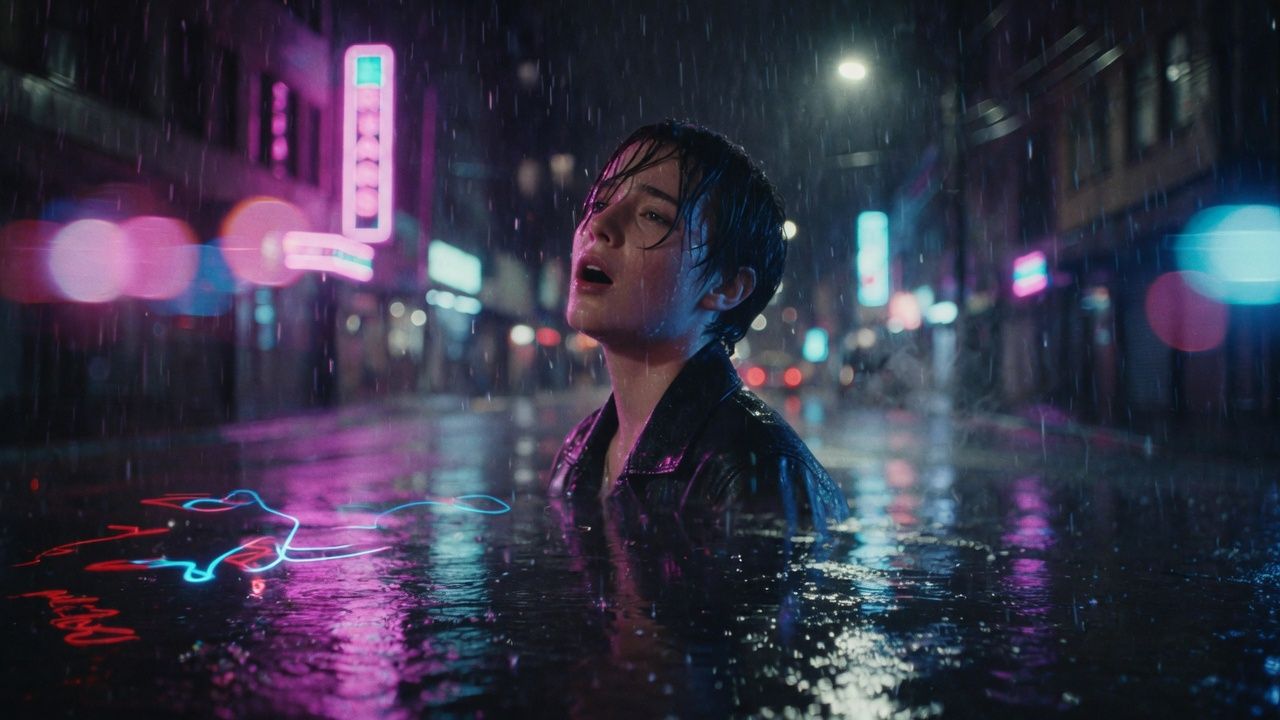
Image: SunoMV Team. A music-video still of the shape a Veo prompt can follow: camera, subject, weather. Not a Lite generation.
Practical rule: Camera first, one action second, locks last. Nothing about sound, because this row has none.
10 copy-paste tips
Each tip is a full block. Pick Veo 3.1 Lite, paste into the shot description, generate, then cut the 8 seconds onto the lyric. The page is the audio-to-video generator.
1. Write the shot to fit eight seconds
One-line rule: the row makes one 8-second take. Give it one action that finishes inside that.
Medium close-up, eye-level, slow push-in over 8 seconds.
A woman in an oxblood leather jacket stands in rain on a neon side street and mouths one line of the chorus, left heel planted.
Do not recast. No subtitles.
Duration: 8 seconds. Aspect ratio: 16:9.
Anti-example: Full chorus, three locations, wardrobe change, 20 seconds.
2. Name the camera in the first clause
One-line rule: a named move beats a mood word.
Low angle, slow dolly-in at walking pace.
A singer in a soaked black jacket under a magenta shop sign, rain beading on the collar.
Hard key from camera-left neon, soft fill from a shop window on the right.
Duration: 8 seconds. Aspect ratio: 16:9.
Anti-example: Cinematic music video of a singer, highly detailed, 8K.
3. Show the line with the mouth, not with quotes
One-line rule: Lite has no audio, so a quoted line only gives you moving lips. Cut the song over it in the editor.
Close-up, static. A woman in a grey coat on a quiet train platform looks into lens and mouths a slow phrase, lips clearly shaped, no smile.
Duration: 8 seconds. Aspect ratio: 9:16.
Anti-example: She says "I kept the light on for you" in a low voice.
4. Let the song be the score
One-line rule: do not write a sound line. Describe motion that can be cut to a beat.
Wide shot from across the street. A figure in an oxblood jacket walks away under neon.
Camera stays put. Rain streaks across the sign.
One clear step per second so the cut can land on the beat.
Duration: 8 seconds. Aspect ratio: 16:9.
Anti-example: Epic trap drop, full mix, perfect lip sync to these lyrics: ...
5. Use one still as the first frame
One-line rule: the still holds the look; the prompt says what moves next.
The uploaded still is the first frame: oxblood jacket, blunt black bob, rain.
Next: she takes one slow step toward lens, hem swinging. Same jacket, same bob.
Camera: slow push-in, 35mm, eye-level.
Duration: 8 seconds. Aspect ratio: 16:9.
Anti-example: Make my photo cinematic.
6. Pair a first and last frame, then describe only the move
One-line rule: the frames hold identity. The prompt is the bridge.
First frame: the singer on a subway platform, red coat, facing the tracks.
Last frame: the same singer, same red coat, stepping into the train car.
She turns and steps through the doors as they open.
Camera: side angle, short tracking move with her, steady.
Duration: 8 seconds. Aspect ratio: 16:9.
Anti-example: a first frame at noon and a last frame at night in a different coat.
7. Use up to three references, and say which does what
One-line rule: three is the cap on this row. Give each one a job.
Reference 1 is the singer: same face, blunt black bob, silver hoops.
Reference 2 is the street: narrow alley, vending machines on the right.
Reference 3 is the jacket: oxblood leather, white tank underneath.
She walks toward camera down the alley, left heel striking wet asphalt.
Camera: medium shot, slow dolly back.
Duration: 8 seconds. Aspect ratio: 16:9.
Anti-example: Use all my photos, make it look like the vibe.
8. Do not ask for a resolution
One-line rule: the row renders 720P only. A resolution line adds nothing, and a 4K line is a promise the row cannot keep.
Close-up, rain beads on the oxblood shoulder, one silver hoop at the frame edge. Slow drift left.
Keep the frame simple: one subject, one light, a plain dark background so 720P stays clean.
Duration: 8 seconds. Aspect ratio: 16:9.
Anti-example: 4K IMAX, best quality, ultra detailed.
9. Replace the missing negative box with closing locks
One-line rule: there is no negative field, so the locks live in the last lines.
Do not recast. Do not add a second person. Do not change the jacket colour. No subtitles. No logo.Anti-example: Negative prompt: blur, watermark, extra fingers, bad anatomy.
10. Repeat the wardrobe in the next shot
One-line rule: each clip is its own take. The next one matches only if the words match, or if you feed in a reference.
Same woman as the previous shot: oxblood leather jacket, blunt black bob, silver hoops.
Wider frame, two steps further down the same street, same rain. Slow track at her shoulder.
Duration: 8 seconds. Aspect ratio: 16:9.
Anti-example: Next shot, surprise me with a new outfit.

Image: SunoMV Team. A shot written as camera plus subject plus light. Not a Veo 3.1 Lite generation.
Practical rule: One shot, one action, locks at the end. If you need a longer take, plan several 8-second clips and cut them on the timeline.
5 music-video templates
Paste one. Swap the jacket and the street. Leave the shape.
Chorus push-in
Medium close-up, eye-level, 35mm, slow push-in.
Oxblood leather jacket, blunt black bob, silver hoops, left heel planted, mouths the chorus.
Neon side street, rain.
Do not recast. No subtitles.
Duration: 8 seconds. Aspect ratio: 16:9.
Vertical hook
Duration: 8 seconds. Aspect ratio: 9:16.
Close-up, oxblood collar, one silver hoop, rain in front of the lens.
She turns her chin a few degrees toward lens. No cut.
Beat-cut walk
Wide shot, locked off. A lone figure in a long grey coat walks along a harbour wall.
One clear step per second.
Blue hour, sodium lamps coming on, calm water.
Duration: 8 seconds. Aspect ratio: 16:9.
From one still
The uploaded still is frame one: oxblood jacket, blunt bob, rain.
She takes one step toward lens. Same jacket. Same bob.
Camera: slow push-in.
Duration: 8 seconds. Aspect ratio: 16:9.
Object insert
Extreme close-up of a silver ring on a hand resting on a piano, a single warm lamp behind.
The hand lifts slowly and the ring catches the light once.
Camera: static macro.
Duration: 8 seconds. Aspect ratio: 16:9.
The model row is where you pick Lite. The prompt does not grow extra boxes.
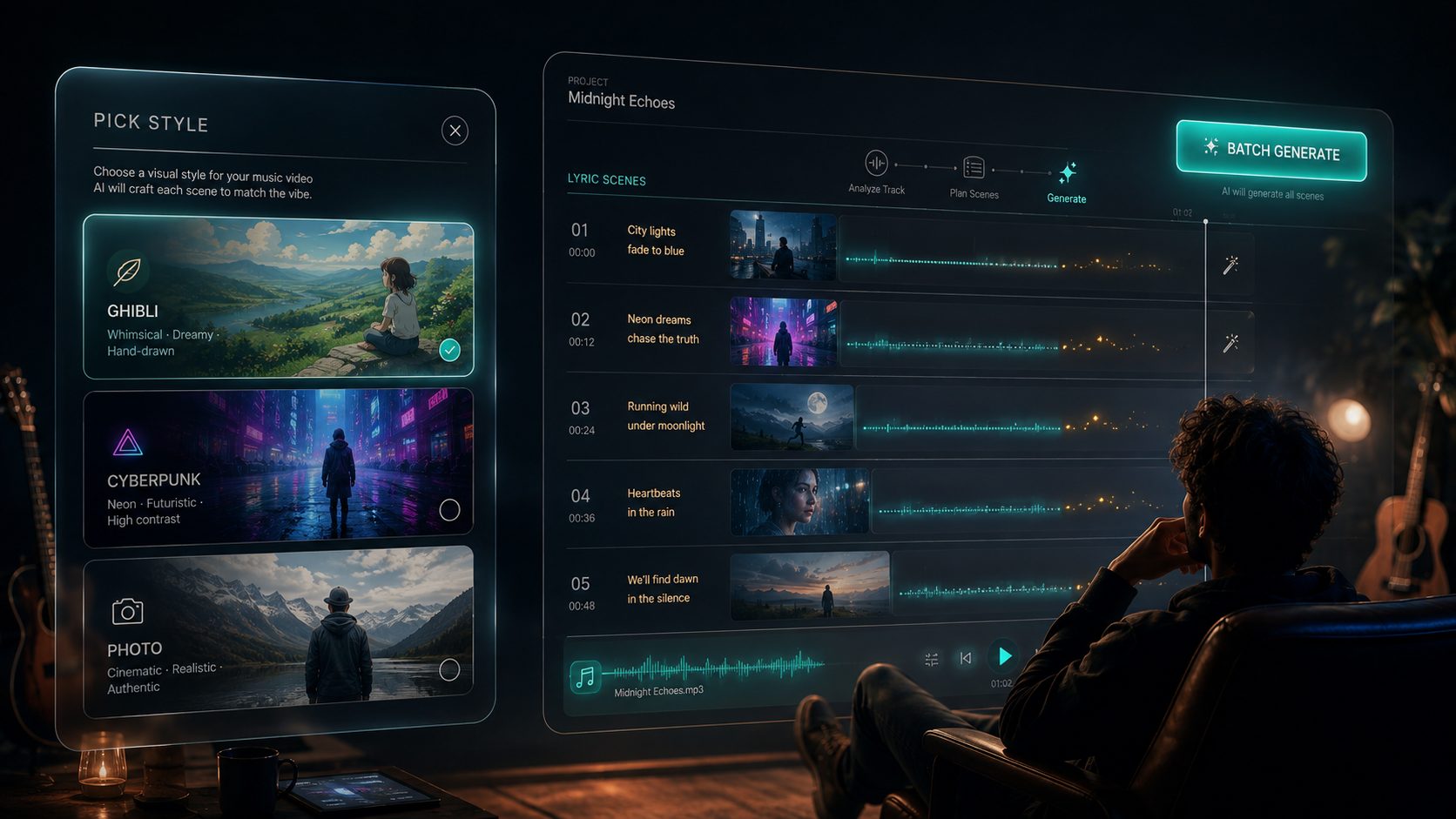
Image: SunoMV Team. Lite is a row in the model list. Paste the brief, then batch the shots.
Lite vs Fast vs Omni
Three Google rows sit near each other in the picker. They are not interchangeable, and a prompt written for one does not always carry over.
| You wrote | Veo 3.1 Lite | Veo 3.1 Fast | Gemini Omni |
|---|---|---|---|
| A quoted spoken line or named sound | Not this row. Lite is silent | Works, audio is generated | Works, audio generated |
| Length | Fixed 8 seconds | Fixed 8 seconds | 3 to 15 seconds |
| Resolution | 720P only | 720P, 1080P | Up to 4K |
| Three reference stills | Yes | Yes | Yes |
| Price on SunoMV | 160 credits per clip | 320 credits per clip | 200 credits per 5 seconds |
If you only need a silent picture to lay your Suno track under, Lite is the cheaper clip. If the shot needs speech, named noises or 1080P, switch to Fast and add the Sound: line. If you need a take longer than 8 seconds, use the Omni row; the Gemini Omni 1.2 Flash prompt guide has the blocks for that.
Practical rule: Silent, short, cheap goes on Lite. Sound goes on Fast. Length beyond 8 seconds goes on Omni. Delete what a row cannot do before you paste.
FAQ
Can I paste my Veo 3.1 Fast prompt into Lite?
Yes, if you delete the Sound: line and any quoted speech. Keep the camera, subject, action, context and style lines. Lite will draw the picture; it just cannot voice it.
Why does the clip always stop at 8 seconds?
The row is fixed at 8 seconds on SunoMV, which is a model limit. Plan the chorus as several clips and cut them together.
Why is Lite 160 credits and Fast 320?
That is the model list: 160 credits per 8-second clip for Lite, 320 for Fast. Lite is the lower-cost no-audio option at 720P; Fast makes sound with the picture and offers 1080P.
Will an opening image keep the face for the next shot?
It keeps the first frame of this shot. For the next one, repeat the wardrobe in words or feed the same reference stills again.
Where do I paste this?
Pick Veo 3.1 Lite on the audio-to-video generator. One prompt is one silent 8-second shot.
Copy, pick Lite, export the shot
Paste a block from the tips or the templates. Keep it inside eight seconds and inside one action. Leave sound out, since the row has none and your Suno track already carries the score. If the next angle needs the same person, repeat the wardrobe or reuse the references. If the shot needs more than eight seconds, switch rows instead of stretching the words.
A still to use as the opening frame can start from the musician image prompt maker. For a transcript of a clip you are matching, BibiGPT’s transcript page gives you the text, not the video. A still you need to redraw first can go through ChatImg and come back as frame one.
Practical rule: The prompt is done when a stranger can paste it and get one length, one action, and one silent picture, with nothing left that needs a ninth second or a sound card.
Made in SunoMV · real exports
See what a song turns into
Every sample below is an untouched SunoMV export: 3 AI storyboard shots, one AI-filmed clip, then the lyrics. Each one uses a different caption style and frame size.
Popular guides
More in this series
- Veo 3.1 Fast Prompt Guide: 10 Tips + Copy-Paste Templates
- Gemini Omni 1.2 Flash Music Video Prompts: 8 Copy-Paste Templates
- FLUX 3 Max Prompt Guide: 10 Tips + Copy-Paste Templates
- Grok Imagine 1.5 Lite Prompt Guide: 10 Tips + Copy-Paste Templates
- Kling 4.0 Prompt Guide: 10 Tips + Copy-Paste Templates